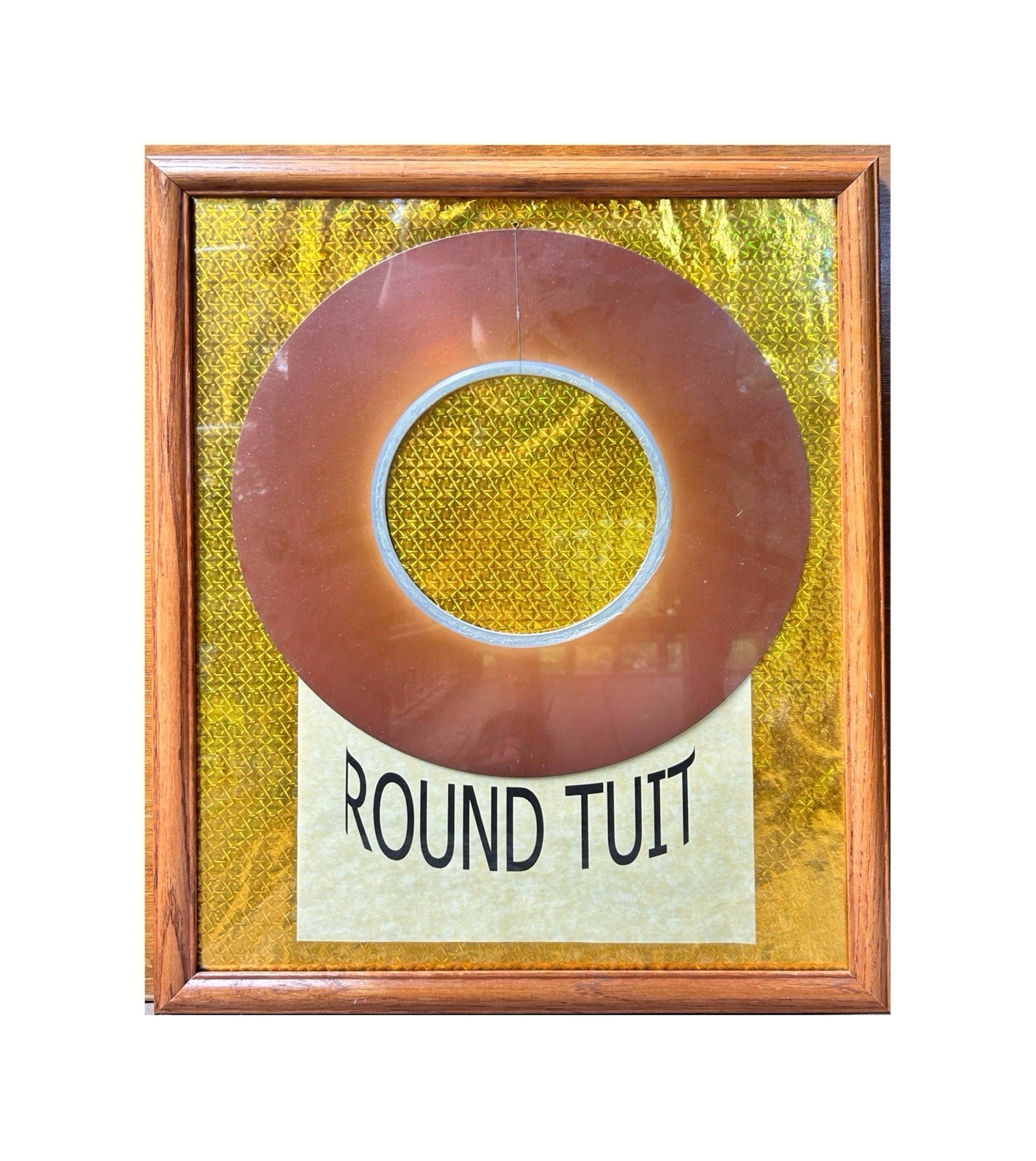
This extremely cool Vintage computer nerd memorabilia and motivational artwork is straight out of the movie. Real Genius or Revenge of the Nerds . This one of a kind work of art consists of an early 14" Mainframe 3330 Computer Hard Drive Storage Platter mounted onto very groovy golden rainbow sheen holographic paper (novel for its time) and beautifully framed into a fine piece of unique Folk Art.
"Round Tuit" mounted and framed with holographic background is a nostalgic piece from the early 1980’s featuring a hard drive platter from a retro computer system.
This unique item is from the Estate of a scientist who worked at a facility like Oak Ridge and serves as a functional and decorative piece, perfect for vintage computing enthusiasts or collectors looking to add a piece of technology history to their collection. The round shape of the storage platter adds a touch of whimsy to the design, making it a standout conversation piece in any space.
The IBM 3330 (code-named "Merlin") was a landmark 1970 direct-access mainframe storage system. Instead of sealed assemblies, it used large, removable disk packs containing multiple 14-inch rigid platters.
Specs & Engineering
Capacity: 100 MB per disk pack (Model 1); the later 1973 Model 11 doubled capacity to 200 MB.
Platter Size: 14 inches in diameter.
Revolutionary Tech: It was one of the first systems to utilize built-in error-correction circuitry, allowing the read/write heads to tolerate minor surface imperfections.
Dimensions & Weight: A stack of disks sat in a protective canister and was swapped by operators via manual drawers.
Historical Context
The IBM 3330 paved the way for "Winchester" technology. Before Winchester drives—which sealed the heads and platters together—operators physically lifted heavy 3330 disk packs in and out of the mainframe drives.
Novelty holographic paper and wrapping paper became widely popular after the invention of embossed holograms in the mid-1970s. This breakthrough allowed complex holograms to be mass-produced cheaply on metalized film and paper. The foundational science of holography was theorized decades earlier, beginning with Dennis Gabor's invention in 1947.
Here is the timeline of how holographic paper transitioned from concept to consumer product:
• 1947-1948: Hungarian-British physicist
Dennis Gabor formulated the science of holography (a discovery that earned him the
1971 Nobel Prize in Physics).
• Early 1960s: The invention of the laser provided the coherent light sources required to make practical, clear, and recognizable 3D holograms.
• Mid-1970s: The embossed hologram technique was developed. This allowed interference patterns to be stamped onto rolls of plastic film and foil, paving the way for cheap, mass-produced decorative and novelty "holographic" paper.
• 1980s-1990s: The "rainbow effect" or
"diffraction grating" foil paper exploded as a novelty item, finding widespread use in gift wrap, greeting cards, and crafts.
Novelty holographic paper and stickers became widely accessible to the general public in the early to mid-1980s. Following advancements in mass-production rainbow holography in the 1970s, the technology transitioned from specialized scientific and art laboratories into mainstream commercial products, hitting novelty shelves around 1984.
The transition of holography into accessible, decorative formats for the general public was driven by a few key milestones in the early 1980s:
• 1982: Companies like the American Bank Company (and later Hallmark) began experimenting with embossed holograms, leading to the production of novelty stickers and greeting cards.
• 1984: Inexpensive foil stickers and holographic paper became common and widely accessible. This was the same year National Geographic pushed the limits of popular print media by featuring a hologram on its March cover.
• 1990s: Decorative holographic gift wrap, shiny foils, and paper derivatives became a common sight in everyday retail and craft stores.