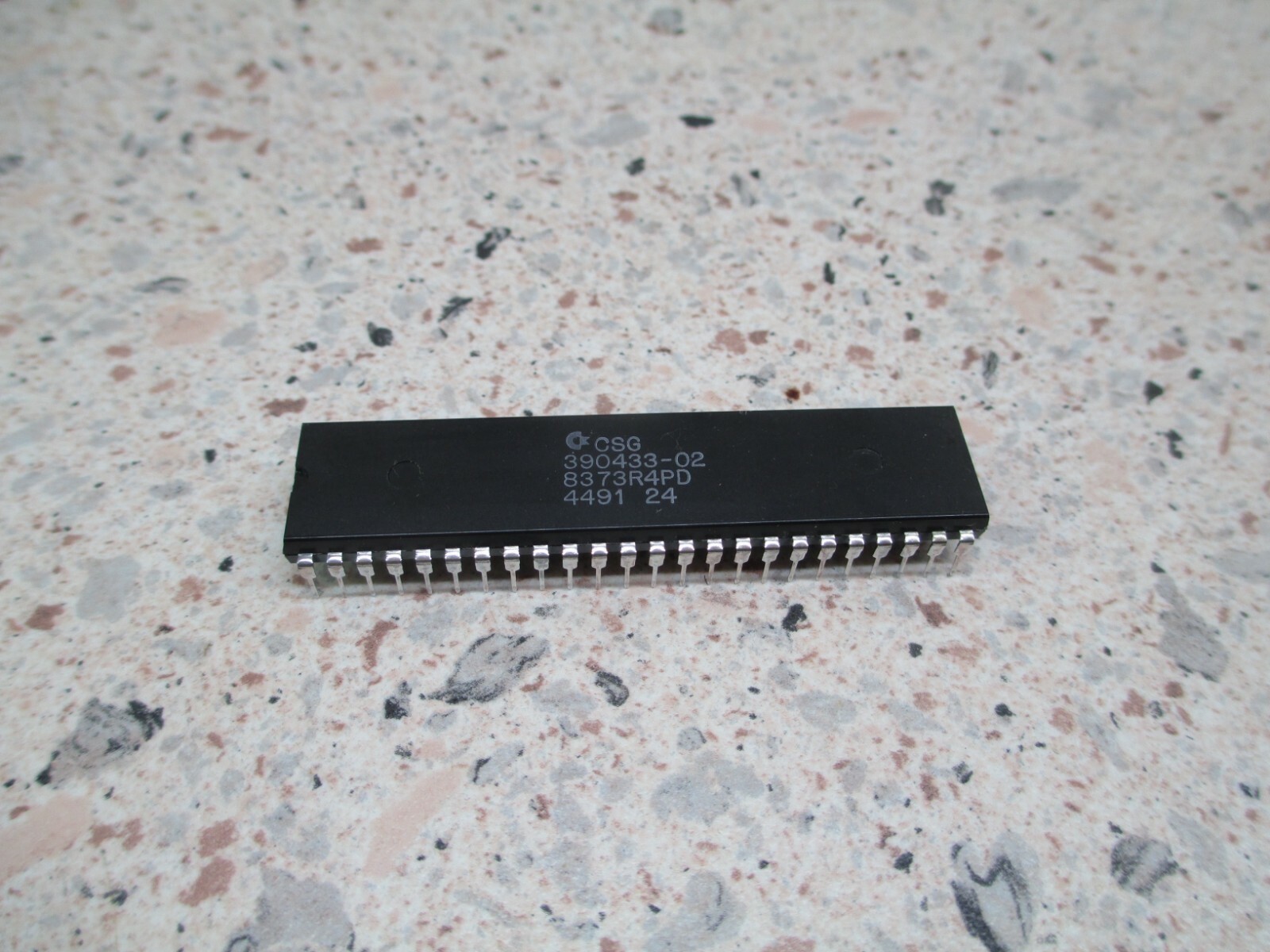
The A500 machines shipped with a graphics chip called ‘Denise’ that is responsible for handling sprites and also all the different screen modes and resolutions you can use with Workbench and other apps. The later Amiga 500+ model sported an updated chip called ‘Super Denise’ which offered quite a few more screen modes and resolution options. The Amiga 500 Super Denise upgrade is a very straightforward modification which simply involves getting hold of the newer chip and replacing the old one with it. (It is an exact pin-for-pin replacement).
Denise is the main video processor. Without using overscan, the Amiga's graphics display is 320 or 640 pixels wide by 200 (NTSC) or 256 (PAL) pixels tall. Denise also supports interlacing, which doubles the vertical resolution, at the cost of intrusive flickering on typical monitors of that era. (Various flicker fixer solutions appeared.) Planar bitmap graphics are used, which splits the individual bits per pixel into separate areas of memory, called bitplanes. In normal operation, Denise allows between one and five bitplanes, giving two to 32 unique colors. These colors are selected from a palette of 4096 colors (four bits per RGB component). A 6th bitplane is available for two special video modes: Halfbrite mode and Hold-And-Modify (HAM) mode. Denise also supports eight sprites, single pixel scrolling, and a "dual-playfield" mode. Denise also handles mouse and digital joystick input.
The 8362 Denise in the OCS chipset is directly pin-compatible with the 8373 Super Denise from the ECS chipset and both can be used interchangeably in the A500, A500+, A2000, and CDTV machines. In order to use the enhanced display modes Super Denise requires an ECS Fat Agnus – 8372A or above. Super Denise will still work with OCS Fat Agnus but will be unable to use her superpowers.Tested and working.
Machine pulls.