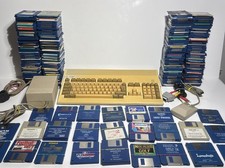
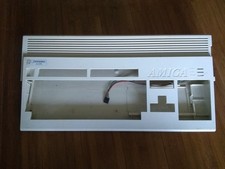
Appearance: Used, missing componentsFunctionality: Working
Description:============As pictured, a Commodore/Amiga A1200 computer – tested good. Includes everything shown: motherboard, top and bottom case, Kickstart 3.1 ROMs, and floppy drive – no other accessories are available.
Warranty and Returns:=====================We understand that there may be compatibility issues, space constraints, or it just doesn’t look perfect. This item can be returned within 14-days for ANY reason. However, shipping to and from is not refundable.
Shipping:=========- Other shipping methods are available – contact us for details.- Combined shipping is available for most items – contact us for details.- Local pickup is also available at no cost.
Stock#:J20584.NUNDR#7Details from wikipedia:
The Amiga 1200, or A1200 (code-named 'Channel Z'), was Commodore International's third-generation Amiga computer, aimed at the home computer market. It was launched on October 21, 1992, at a base price of £399 in the United Kingdom and $599 in the United States.
History[edit]
Like its predecessor, the Amiga 500, the A1200 is an all-in-one design incorporating the CPU, keyboard, and disk drives (including the option of an internal 2.5" hard disk drive) in one physical unit. The A1200 has a similar hardware architecture to Commodore's Amiga CD32 game console, and is technically close to the Atari Falcon, which was intended as the A1200's competitor.[1]
Initially, only 30,000 A1200s were available at the UK launch.[2] During the first year of its life the system reportedly sold well, but Commodore ran into cash flow problems and filed for bankruptcy.[3] World wide sales figures for the A1200 are unknown but 95,000 systems were sold in Germany before Commodore's bankruptcy.[4]
After Commodore’s demise in 1994 the A1200 almost disappeared from the market but was later re-launched by Escom in 1995. The new Escom A1200 was priced at £399 and it came bundled with two games, seven applications and Amiga OS 3.1.[5] It was initially criticized for being priced 150 pounds higher than the Commodore variant had sold for two years prior. It also came with a modified PC floppy disk drive that was incompatible with some Amiga software. The A1200 was finally discontinued in 1996 as the parent company folded.[6]
Design Improvements[edit]
The A1200 offers a number of advantages over earlier budget Amiga models. Specifically, it is a 32-bit design, the 68EC020 microprocessor is faster than the 68000 and has 2 MB of RAM as standard. The AGA chipset used in the A1200 is a significant improvement. AGA increases the color palette from 4096 colors to 16.8 million colors with up to 256 on-screen colors and an improved HAM mode allowing 262,144 on-screen colors. The graphics hardware also features improved sprite capacity and faster graphics performance mainly due to faster video memory. Additionally, compared to the A600 the A1200 offered greater expansion possibilities.
Technical information[edit]
Processor and RAM[edit]The A1200 has a Motorola 68EC020 CPU. It is noteworthy that, like the 68000, the 68EC020 has a 24-bit address space; allowing for a theoretical maximum of 16 MB of memory. A stock A1200 has 2 MB of inbuilt Chip RAM (Chip RAM cannot be expanded beyond 2 MB). Up to 8 MB of "fast" RAM can be added in the "trapdoor" expansion slot, which approximately doubles (~2.26×) the speed of a stock machine. Various CPU upgrades featuring 68020, 68030, 68040, 68060 and even PowerPC processors were made available by third-party developers. Such upgrades typically utilize faster and greater capacity memory (up to 256 MB).[9]
Graphics and sound[edit]
The A1200 shipped with Commodore's third-generation Amiga chipset, the Advanced Graphics Architecture (AGA), which features improved graphical abilities in comparison to the earlier generations.
However, the sound hardware remains identical to the design used in the Amiga 1000, though the AGA chipset allows higher sampling rates for sound playback, either by using a video mode with higher horizontal scan rate or by using the CPU to drive audio output directly.
Peripherals and expansion[edit]
Like earlier models, the A1200 features several Amiga compatible connectors including two DE9M ports for joysticks, mice, and light pens, a standard 25-pin RS-232 serial port and a 25-pin Centronics parallel port. As a result, the A1200 was compatible with many existing Amiga peripherals, such as external floppy disk drives, MIDI interfaces, sound samplers and video digitizers.
Like the earlier Amiga 600 the A1200 features a PCMCIA Type II slot and an internal 44-pin ATA interface both most commonly seen on laptop computers. The A1200 has internal housing for one 2.5" internal hard disk drive connecting to the ATA controller, though it is also possible to accommodate slim 3.5" drives with suitable cabling and fixings. The 16-bit PCMCIA Type II interface allows use of a number of compatible peripherals available for the laptop market, though only 16-bit (Type II) PCMCIA cards are hardware compatible, newer 32-bit PC Card or CardBus peripherals are incompatible. The PCMCIA implementation is almost identical to the one featured on the earlier A600. A number of Amiga peripherals were released by third-party developers for this connector including SRAM cards, CD-ROM controllers, SCSI controllers, network cards, sound samplers and video digitizers. Later, a number of compatible laptop peripherals have been made to operate with this port including serial modems, wired and wireless network cards and CompactFlash adaptors.
In addition the A1200 features a 32-bit CPU/RAM expansion slot and a feature unique to the A1200, the so-called 'clock port'. The clock port is a remnant of an abandoned design feature for addition of internal RAM and a real time clock. Later, third-party developers put it to use by creating an array of expansions for the A1200, such as, I/O cards, audio cards[10] and even a USB controller.[11] Several CPU boards also have integrated SCSI controllers or even the option to add a graphics card.
One problematic factor for expanding the A1200 is the rather limited 23 watt power supply. Hard disks and even external floppy drives can stress the power supply leading to system instability. The problem can be mitigated by replacing the stock power supply with a higher rated supply, such as the one supplied with the A500.
The A1200 became a popular machine for 'modding'. If one is willing to forgo the A1200's form-fitting desktop case in exchange for further expansion options it is possible to re-house the hardware into alternative casing. Several third-party developers built and supplied popular kits to 'tower up' the A1200 and in essence convert it to a 'big box' Amiga. These expansion kits allow use of PC AT Keyboards, hard disk bays, CD-ROM drives, and Zorro II, Zorro III and PCI expansion slots. Such expansion slots made it possible to use devices not originally intended for the A1200, such as graphic, sound and network cards.
The revision of the A1200 manufactured by Escom was fitted with PC-based 'high density' floppy disk drives that had been downgraded to double density drives. This resulted in some software incompatibility (PC style drives do not supply a "ready" signal, which signals if there is a floppy in the disk drive.)[12] Escom released a free circuit upgrade to correct this issue.
Specifications[edit]Processor Motorola 68EC020 at 14.32 MHz (NTSC) or 14.18 MHz (PAL)RAM 2 MB Amiga Chip RAM
Upgradeable by further:8 MB in the expansion slot without CPU upgrade256 MB in the expansion slot with CPU upgrade4 MB in PCMCIA slotROM 512 kB Kickstart ROMChipset Advanced Graphics Architecture (AGA)Video 24-bit color palette (16.8 Million colors)
Up to 256 on-screen colors in indexed mode262,144 on-screen colors in HAM-8 modeResolutions from:320×200 to 1280×400i (NTSC)320×256 to 1280×512i (PAL)640×480 (VGA)800×600i, 1024×768i (not officially supported)Audio 4 × 8-bit PCM channels (2 stereo channels)
28–56 kHz maximum DMA sampling rate (dependent on video mode in use)Removable storage 3.5" DD floppy disk drive (880 kB capacity)Internal storage Housing for 2.5" IDE hard disk driveAudio/video out Analog RGB video out (DB-23M)
Composite video out (RCA)RF audio/video out (RCA)Audio out (2 × RCA)Input/output ports 2 × Mouse/Gamepad ports (DE9)
RS-232 serial port (DB-25M)Centronics style parallel port (DB-25F)Floppy disk drive port (DB-23F)44-pin ATA controller supporting PIO-0 transfer mode (internal)16-bit Type II PCMCIA slotExpansion slots 150-pin local expansion port (trapdoor)
22-pin clockportOperating system AmigaOS 3.0/3.1. (Kickstart 3.0-3.1/Workbench 3.0-3.1)Physical dimensions 470 × 241 × 76.2 mm (W × D × H)
3.6 kgOther Integrated keyboard with 96 keys (including 10 function keys)